Comprehensive Guide to Coconut Charcoal Wholesale Minimum Orders
Introduction to Coconut Charcoal Wholesale Minimum Orders
As the global demand for sustainable and high-quality fuel alternatives continues to rise, coconut charcoal briquettes have emerged as a frontrunner in both the shisha and barbecue markets. Sourcing these products on a wholesale basis can be highly lucrative, but it requires a solid understanding of the industry's logistics, particularly when it comes to minimum order quantities (MOQs). This comprehensive guide will walk you through the intricacies of navigating a coconut charcoal wholesale minimum order, helping you make informed purchasing decisions for your business.
Understanding Minimum Order Quantities (MOQs)
In the wholesale manufacturing and export industry, a Minimum Order Quantity (MOQ) is the lowest quantity of a certain product that a supplier is willing to sell. For coconut charcoal briquettes, MOQs are typically dictated by production costs, packaging requirements, and most importantly, shipping logistics.
Why Do Suppliers Require MOQs?
Suppliers implement MOQs for several reasons. Firstly, the production process for high-quality coconut charcoal is labor and energy-intensive. Firing up kilns, mixing binders, and operating extrusion machines are costly endeavors that require a certain volume to be economically viable. Secondly, packaging materials such as custom-printed inner boxes and master cartons are usually produced in bulk by third-party printing companies, which also have their own MOQs. Finally, international shipping logistics play a massive role. Most coconut charcoal is shipped in sea freight containers, making it impractical to export small, loose quantities.
Standard MOQs in the Coconut Charcoal Industry
When dealing with international suppliers, particularly from top producing countries like Indonesia, you will find that MOQs are generally tied to container sizes. If you want to dive deeper into sourcing from this region, checking out the Indonesian Coconut Charcoal Briquettes Wholesale: The Ultimate B2B Sourcing Guide is highly recommended.
The 20-Foot Container (20ft FCL)
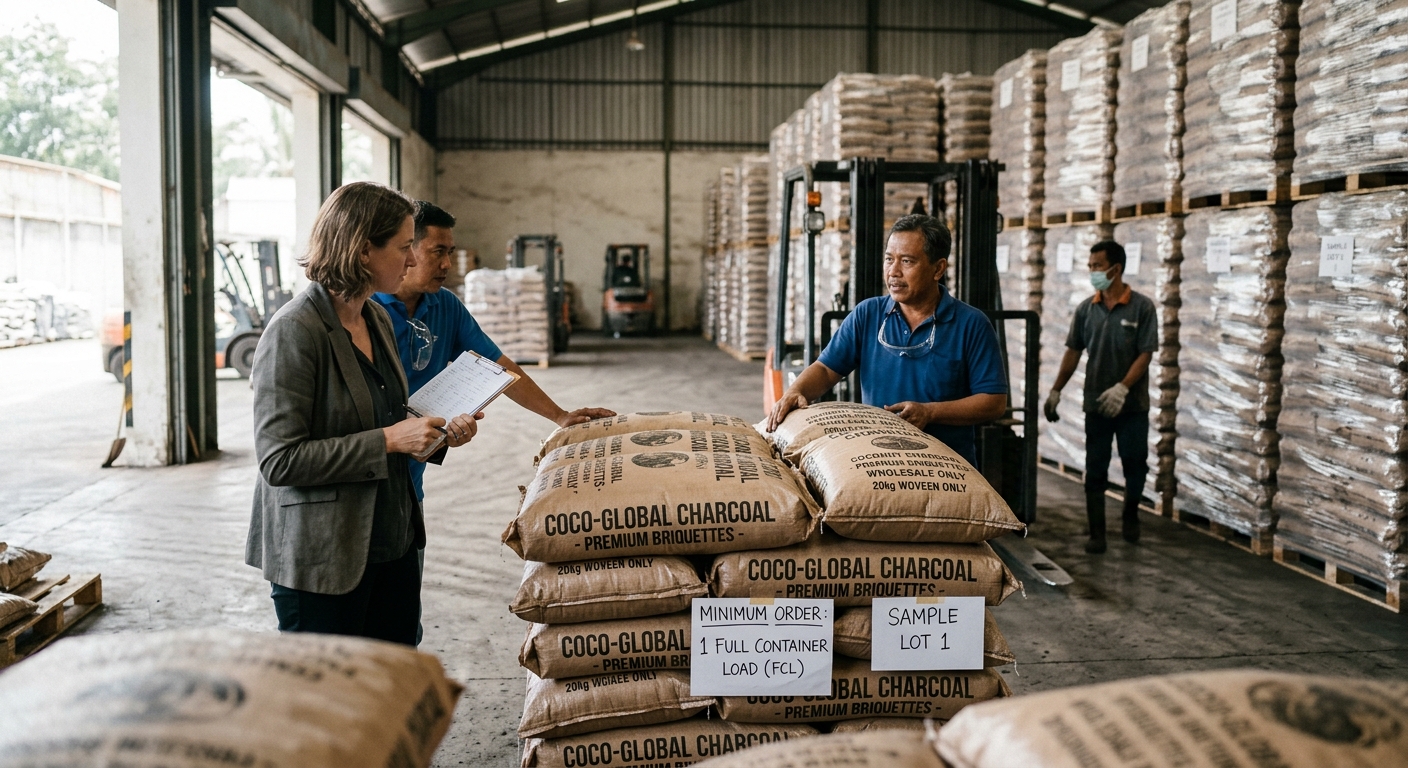
For most wholesale buyers, the standard minimum order for coconut charcoal briquettes is a 20-foot Full Container Load (FCL). Depending on the specific shape and packaging of the briquettes, a 20ft container can hold approximately 18 metric tons (18,000 kilograms). This volume strikes a balance between securing wholesale pricing and managing inventory for medium-sized distributors.
The 40-Foot Container (40ft FCL)
Larger distributors and established brands often opt for a 40-foot container, which typically holds around 25 to 26 metric tons. While the product quantity is higher, the cost of shipping per kilogram decreases significantly, offering better profit margins. Some suppliers may offer slightly better pricing per ton when you commit to a 40ft container due to economies of scale.
Less than Container Load (LCL) Orders
You might wonder if it is possible to order smaller quantities, known as Less than Container Load (LCL). While a few suppliers might agree to LCL shipments (e.g., 5 or 10 tons) for trial purposes, it is generally discouraged in the charcoal industry. Charcoal is considered a dangerous good (DG) under maritime shipping regulations, and consolidating it with other cargo in an LCL shipment can be extremely difficult, expensive, and sometimes outright prohibited by shipping lines.
Factors Influencing Your Initial Order Size
Deciding on your coconut charcoal wholesale minimum order involves analyzing several facets of your business operations.
1. Storage and Warehousing Capacity
Before committing to 18 tons of charcoal, you must ensure you have adequate, dry, and safe storage facilities. Coconut charcoal must be kept away from moisture and extreme heat to maintain its quality and lighting properties.
2. Cash Flow and Budget
Purchasing a full container requires a significant upfront investment, not just for the product itself, but also for shipping, insurance, and import duties. Ensure your cash flow can sustain the period between paying your supplier and eventually selling the product to your end consumers.
3. Market Demand and Turnover Rate
Analyze your current sales velocity. How long will it take you to sell 18 tons? While charcoal has a long shelf life if stored correctly, having capital tied up in slow-moving inventory is a risk for any business.
The Role of Custom Packaging in MOQs
Many wholesale buyers want their coconut charcoal packaged under their own brand (OEM). Custom packaging significantly impacts MOQs.
| Packaging Component | Typical Supplier MOQ | Impact on Order |
|---|---|---|
| Inner Boxes (1kg) | 10,000 to 20,000 pieces | Dictates the total tonnage required for the charcoal. |
| Master Cartons (10kg/20kg) | 1,000 to 2,000 pieces | Relatively easy to meet with a 20ft container order. |
| Inner Plastic Liners | Bulk quantities | Usually absorbed by the supplier, but customized prints require high volumes. |
If your required charcoal volume is lower than the packaging MOQ, suppliers might ask you to pay for the excess packaging upfront. They will then store the remaining boxes for your future orders.
Navigating Shipping and Export Regulations
Fulfilling a coconut charcoal wholesale minimum order isn't just about paying the supplier; it's about successfully transporting the goods. Because charcoal is a combustible material, it is heavily regulated. Understanding these regulations is crucial. We suggest reading the Comprehensive Guide to Indonesia Coconut Charcoal Export Documentation to familiarize yourself with the necessary paperwork, such as the Self-Heating Test (SHT) certificate, Material Safety Data Sheet (MSDS), and Vanning Certificates.
Negotiating with Suppliers on MOQs
While MOQs are generally firm, there is sometimes room for negotiation, especially if you are building a long-term partnership.
- Offer a Higher Price per Ton: If you strictly need a lower quantity for a trial, offer to pay a premium price to offset the supplier's production inefficiencies.
- Standard Packaging: Opting for the supplier's standard, unbranded packaging instead of OEM can sometimes lower the MOQ, as the supplier doesn't need to commit to minimum print runs.
- Long-Term Contracts: Commit to a schedule of future orders. A supplier might accept a smaller initial order if they have a signed contract for full containers in the following months.
Conclusion
Entering the coconut charcoal market offers immense potential, but it requires careful planning regarding your wholesale minimum order. Understanding that standard orders revolve around 20ft and 40ft containers due to logistical and production constraints is the first step. By carefully assessing your warehousing capabilities, cash flow, and market demand, and by familiarizing yourself with the necessary export documentation, you can successfully navigate MOQs, establish strong relationships with reliable suppliers, and build a profitable charcoal distribution business.
Frequently Asked Questions
What is the absolute minimum amount of coconut charcoal I can buy wholesale?
While standard wholesale orders are 20ft containers (approx. 18 tons), some suppliers might allow a trial order of 1 to 5 tons. However, be prepared for significantly higher shipping costs and product prices per kilogram.
Can I mix different shapes of charcoal in one container to meet the MOQ?
Yes, most suppliers will allow you to mix different shapes (like cubes, flats, or hexagonal) within a single 20ft or 40ft container order, provided you meet the minimum packaging requirements for each specific shape.
Why is LCL (Less than Container Load) shipping not recommended for charcoal?
Charcoal is classified as a hazardous material for shipping purposes. Consolidators are often reluctant to put it in the same container as other goods, making LCL shipping very expensive, complicated, or entirely unavailable for this specific product.