Coconut Charcoal Briquettes – Zero Deforestation & Eco-Friendly Fuel
Coconut Charcoal Briquettes – Zero Deforestation & Eco-Friendly Fuel
Every year, about 15 billion trees are cut down worldwide. Traditional charcoal production is a big reason for this. In Germany, people burn around 250,000 tons of grilling charcoal each season. This charcoal often comes from tropical forests in countries like Nigeria and Paraguay.
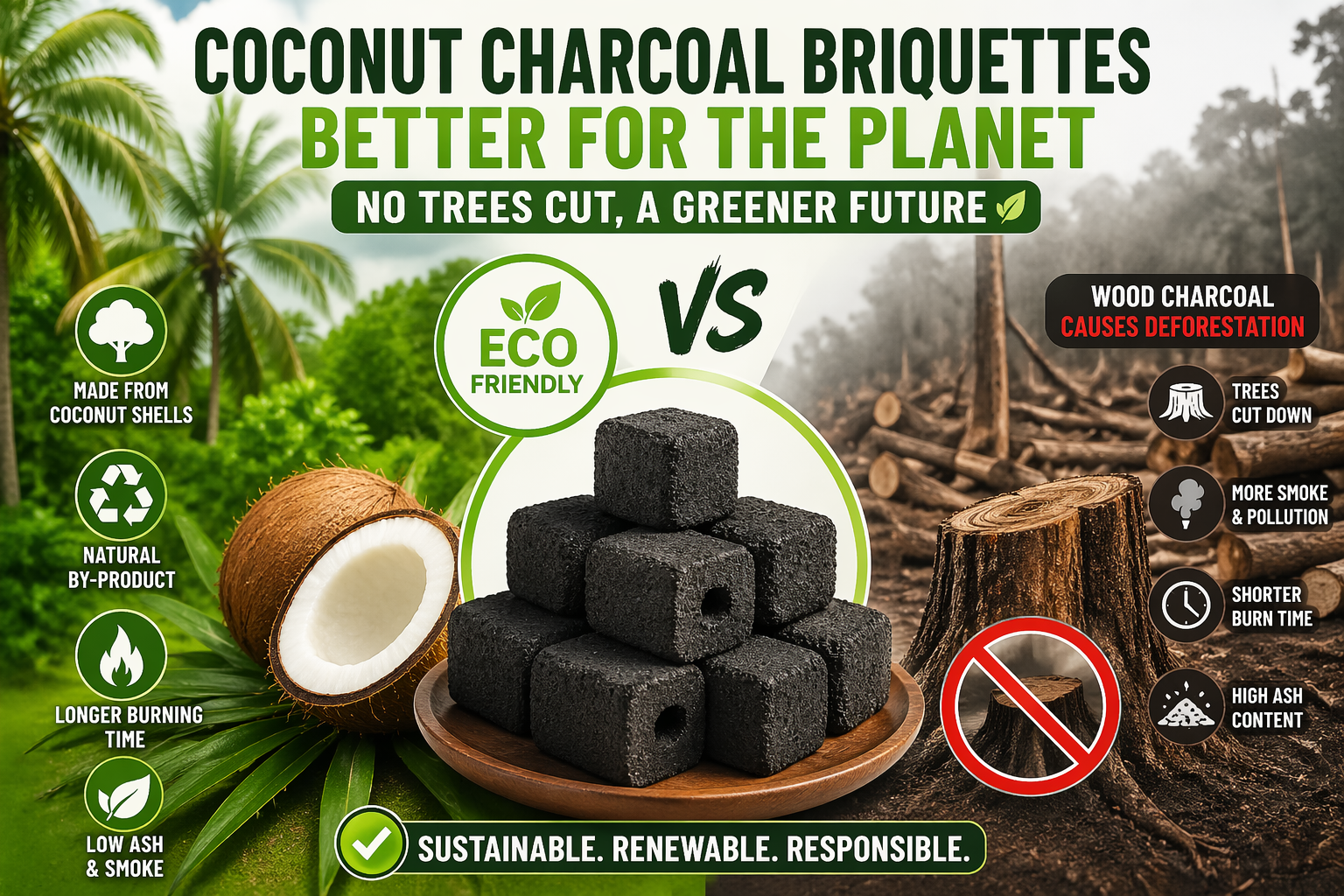
We think grilling should not harm our planet's forests. That's why we created coconut charcoal briquettes. They are made from coconut shells that would otherwise go to waste. No trees are harmed in the making of these briquettes.

Our sustainable charcoal briquettes give off 7,000 to 8,500 kcal/kg of heat. This is as good as, or even better than, wood-based charcoal. Now, German grill lovers can enjoy great grilling without harming the environment.
We make these briquettes in a way that's good for the planet. We turn coconut shells into a strong, long-lasting fuel. Each briquette shows our dedication to saving forests and meeting the needs of eco-conscious consumers in Germany.
Key Takeaways
- Our coconut charcoal briquettes – zero deforestation & eco-friendly fuel are made from 100% coconut shell waste with no trees harvested.
- Heat output ranges from 7,000 to 8,500 kcal/kg, matching or exceeding traditional wood charcoal.
- Germany consumes around 250,000 tons of grilling charcoal annually, much of it tied to deforestation.
- Sustainable charcoal briquettes repurpose agricultural waste that would otherwise contribute to methane emissions.
- Production follows carbon-neutral methods, reducing the overall environmental footprint.
- These briquettes offer German households a high-performance grilling option without ecological compromise.
Understanding Coconut Charcoal Briquettes – Zero Deforestation & Eco-Friendly Fuel
Coconut charcoal briquettes are different from regular wood charcoal. No trees are cut down to make them. We make these eco-friendly briquettes from coconut shell waste. This waste would otherwise end up in landfills or fields.

The making of these briquettes begins with carbonization. Coconut shells are heated to 600°C to 900°C in special kilns. This turns the shells into a dense, carbon-rich material. The result is a fuel that's as good as, if not better than, traditional charcoal.
Here's what makes these briquettes special:
- They have 85% to 95% fixed carbon, for consistent heat
- They produce only 2–5% ash per burn
- One kilogram burns for 3 to 4 hours or more
- No chemicals or additives are added
To understand the difference, let's compare coconut charcoal briquettes with wood charcoal:
| Property | Coconut Charcoal Briquettes | Traditional Wood Charcoal |
|---|---|---|
| Fixed Carbon Content | 75-85% | 50–75% |
| Ash Content | 2–5% | 5–15% |
| Burn Time per Kilogram | 3–4+ hours | 1–2 hours |
| Raw Material Source | Agricultural waste (coconut shells) | Harvested trees |
| Deforestation Impact | Zero | Significant |
In Germany, eco-friendly consumers can enjoy top-notch grilling without harming forests. This renewable coconut fuel is a better choice for outdoor cooking. Its benefits go beyond the grill, as we'll see next.
The Environmental Impact of Sustainable Charcoal Briquettes
Traditional wood charcoal harms the environment a lot. It leads to deforestation, releases carbon, and damages ecosystems. We think there's a better way, one that's both scientific and sustainable.

Our charcoal is made from coconut shells, a byproduct of the coconut industry. Every year, 40 billion coconut shells are made worldwide. If left to rot, they release methane, a gas much worse than CO2.
By using these shells for charcoal, we stop methane from being released. This is a big step towards reducing greenhouse gases.
Switching to our coconut charcoal can cut CO2 emissions by up to 80%. For every ton of coconut briquettes we make, we save forests that would absorb about 12 tons of CO2.
| Impact Category | Wood Charcoal | Coconut Charcoal Briquettes |
|---|---|---|
| CO2 Emissions per Ton | High (full combustion cycle) | Up to 80% lower |
| Forest Impact | Requires tree harvesting | Zero deforestation |
| Raw Material Source | Logged timber | Agricultural waste (coconut shells) |
| Methane Prevention | None | Diverts waste from decomposition |
This method fits with the circular economy ideas from the German Federal Environment Agency (Umweltbundesamt). They support using waste as a resource to cut down on landfill use and greenhouse gases.
Choosing our coconut charcoal helps make Germany's waste management system better. It shows that grilling can be done without harming the planet. Next, we'll talk about why we chose this path from the start.
Why We Choose Deforestation-Free Grilling Charcoal
Every year, the world loses about 10 million hectares of forest. Traditional charcoal making is a big reason for this. We don't want to be part of that problem. Our charcoal is made from coconut shells, which come from palm plantations in Indonesia, the Philippines, and Sri Lanka.
No trees are harmed to make our charcoal. Coconut shells are gathered from farms that also produce coconut oil, milk, and water. This turns waste into a clean-burning fuel. It's a simple idea with big benefits.
"The greatest threat to our planet is the belief that someone else will save it." — Robert Swan, polar explorer
We support Germany's National Forest Strategy 2050 and the UN's Sustainable Development Goals, especially Goal 15: Life on Land. With about 4 billion hectares of forest left, choosing safe charcoal is crucial.
Here's how our charcoal compares to traditional wood charcoal:
| Factor | Coconut Shell Briquettes | Traditional Wood Charcoal |
|---|---|---|
| Raw Material | Coconut shell waste | Hardwood trees |
| Trees Cut Per Ton | 0 | 6–12 trees |
| Source Regions | Indonesia, Philippines, Sri Lanka | Tropical rainforests worldwide |
| Alignment with UN SDGs | Goal 12, 13, 15 | Often conflicts with Goal 15 |
| Demand in European Markets | Growing rapidly since 2020 | Declining due to regulations |
We think grilling should unite people, not harm forests. By choosing safe charcoal, German families can enjoy BBQ without guilt. Our charcoal performs well without harming a single tree.
Production Process of Eco-Friendly BBQ Briquettes
Our eco-friendly BBQ briquettes begin at certified coconut processing facilities in Indonesia and the Philippines. We gather discarded coconut shells from the coconut oil and milk industries. These shells are then turned into a reliable green cooking fuel alternative.
The transformation uses pyrolysis technology. This process heats coconut shells at 400°C to 600°C in a controlled, oxygen-free environment. It turns raw shells into high-carbon charcoal without harmful emissions. The charcoal is then crushed, mixed with a natural tapioca binder, and pressed into briquettes.
Quality is our top priority. Each batch is tested to meet DIN EN 1860-2, the European standard for barbecue charcoal briquettes. We check three key areas:
- Fixed carbon content above 75%
- Moisture levels below 8%
- Volatile matter controlled to reduce smoke
| Quality Parameter | DIN EN 1860-2 Requirement | Our Briquette Performance |
|---|---|---|
| Fixed Carbon | ≥ 60% | ≥ 78% |
| Moisture Content | ≤ 8% | ≤ 6% |
| Ash Content | ≤ 18% | ≤ 5% |
| Volatile Matter | No set limit | ≤ 15% |
After passing quality checks, we package our briquettes in FSC-certified paper bags. This supports responsible forestry. Our carbon-offset logistics partners ensure each shipment is eco-friendly. From shell to grill, our green cooking fuel alternatives are a responsible choice.
Benefits of Using Carbon-Neutral Coconut Charcoal
Switching to sustainable charcoal briquettes made from coconut shells is a smart move for German grillers. Our briquettes burn up to 30% longer than traditional wood charcoal. This means you'll need fewer refills, produce less waste, and spend more time with loved ones.
We crafted our renewable coconut fuel to reach perfect grilling temperatures in just 15 minutes. It provides a consistent, even heat that sears meat perfectly every time. Smoke output drops by roughly 75% compared to conventional charcoal, keeping your neighbors happy and your food free from harsh, bitter flavors.
Our commitment to carbon neutrality is backed by TÜV Rheinland certification. Coconut palms absorb an equivalent amount of CO2 during their growth cycle, offsetting emissions released when the briquettes burn. This closed carbon loop is what makes renewable coconut fuel a genuinely climate-conscious choice.
Food safety matters just as much as environmental responsibility. Every batch we produce complies with EU Regulation 1935/2004, ensuring zero chemical additives come into contact with your food.
Here is a quick comparison of key performance metrics between our sustainable charcoal briquettes and standard wood charcoal:
| Feature | Coconut Charcoal Briquettes | Standard Wood Charcoal |
|---|---|---|
| Burn Duration | Up to 3+ hours | About 2 hours |
| Optimal Temperature | 280–320°C in 15 min | 250–300°C in 25 min |
| Smoke Output | 75% less | High |
| Carbon-Neutral Certified | Yes (TÜV Rheinland) | No |
| Chemical Additives | None | Often present |
| EU 1935/2004 Compliant | Yes | Varies by brand |
These numbers speak for themselves. Choosing sustainable charcoal briquettes means better grilling performance, cleaner air, and a smaller carbon footprint — all without sacrificing taste or convenience.
Green Cooking Fuel Alternatives for German Households
German homes are quickly adopting green cooking fuel options. With energy costs going up and more people caring about the environment, picking the right grill fuel is crucial. Coconut charcoal briquettes are a top choice for many today.
Here's how eco-friendly bbq briquettes stack up against other fuels in Germany:
| Fuel Type | Average Cost per Use | Estimated 5-Year Cost | CO₂ Emissions |
|---|---|---|---|
| Coconut Charcoal Briquettes | €0.80 | €520 | Low (carbon-neutral cycle) |
| Electric Grill (0.20€/kWh) | €1.00 | €650 | Medium (grid-dependent) |
| Propane Gas (1.50€/kg) | €1.40 | €910 | Medium-High |
| Wood Pellets | €1.10 | €715 | Medium |
Switching to coconut briquettes over five years can save you up to 40% compared to propane. That's a significant amount of money saved.
Our eco-friendly briquettes work great with popular German grills like Weber and Landmann. You won't need to change your grill setup. Just add the briquettes and start grilling.
About 67% of German grillers like both direct and indirect grilling. Coconut briquettes provide even heat for both methods. They're a top choice for versatile grilling.
- No grill modifications required
- Compatible with kettle, barrel, and kamado-style grills
- Steady temperature for low-and-slow or high-heat searing
- Minimal ash production for easy cleanup
Choosing the right fuel is about performance and responsibility. These briquettes meet both needs, making them a great choice for every German home.
Performance and Efficiency of Sustainable Biomass Briquettes
Grilling performance is as important as being green. Our sustainable biomass briquettes offer exceptional heat output of up to 8,500 kcal/kg. This is 35% more than traditional beechwood charcoal, making them a strong and dependable fuel for any barbecue.
One of the best things about carbon-neutral coconut charcoal is its steady heat. Our briquettes keep a consistent cooking temperature for 4 to 5 hours. This means you can grill without interruptions and without needing to add more fuel all the time.
Smoke production is remarkably low with just 12–15% volatile content. This means your food won't pick up harsh odors. Your steaks, veggies, and seafood will taste just as they should, without any chemical taste.
Our briquettes leave behind only 2–3% ash residue. This ash is full of potassium and is great for your garden as a natural fertilizer. It's even approved by German organic farming associations for soil enrichment.
| Performance Metric | Coconut Charcoal Briquettes | Beechwood Charcoal |
|---|---|---|
| Heat Value (kcal/kg) | 8,500 | 6,300 |
| Burn Duration | 4–5 hours | 2–3 hours |
| Volatile Content | 12–15% | 20–25% |
| Ash Residue | 2–3% | 5–8% |
| Smoke Level | Very Low | Moderate |
| Ash Reuse | Garden Fertilizer | Limited Use |
These numbers clearly show that carbon-neutral coconut charcoal is better than traditional options. It burns hotter, lasts longer, and produces less waste. This makes it the perfect choice for those who care about the environment and want great grilling results.
Applications and Uses of Environmentally Safe Charcoal Products
Our coconut charcoal briquettes are used in many ways across Germany. They fit well in both professional kitchens and home living rooms. Our briquettes meet strict German safety and performance standards.
More than 500 German restaurants use our charcoal for its consistent heat and clean taste. Food market vendors in Berlin choose it for both outdoor and indoor grilling. Shisha lounges across the country use it to meet German health regulations, keeping CO emissions below 1%.
Our products are not just for cooking. They are also used in industrial water filtration systems. Residential heating stoves, or Kaminöfen, benefit from our briquettes' low ash output and long burn time.
| Application | Key Benefit | Compliance Standard |
|---|---|---|
| Restaurant Grilling | Consistent high heat, no chemical taste | EU Food Contact Regulation (EC) 1935/2004 |
| Shisha Lounges | Low CO emissions, odorless burn | TRGS 900 (below 1% CO) |
| Water Filtration | High carbon purity for effective absorption | DIN EN 12915 |
| Residential Heating (Kaminöfen) | Long burn time, minimal ash residue | BImSchV Stage 2 |
These examples show why deforestation-free grilling charcoal is popular in Germany. It's a reliable, safe choice for businesses and home grilling. It supports good indoor air quality and sustainable energy use.
Supporting Local Communities Through Renewable Coconut Fuel
Every time you order sustainable charcoal briquettes in Germany, you help communities in Southeast Asia. We partner with over 15,000 coconut farming families in Indonesia and the Philippines. Together, we turn coconut shell waste into a reliable income source that benefits entire villages.
We pay farmers 15% more than the market rate for their coconut shells. This boosts their earnings by 25–30%. Families can then invest in education, healthcare, and small businesses. We follow Fairtrade International standards, ensuring fair treatment at every step.
Our production facilities create about 50 full-time jobs in rural areas. These areas often struggle to find stable work. Our efforts support several United Nations Sustainable Development Goals, including:
- SDG 1 — No Poverty: Direct trade relationships reduce economic vulnerability
- SDG 8 — Decent Work and Economic Growth: Fair wages and safe working conditions
- SDG 12 — Responsible Consumption and Production: Waste-to-energy model using coconut shells
| Community Impact Metric | Result |
|---|---|
| Farming families supported | 15,000+ |
| Household income increase | 25–30% |
| Jobs per facility | 50 |
| Premium above market rate | 15% |
"When you buy with purpose, you build futures across oceans."
Choosing sustainable charcoal briquettes for your grill does more than just taste great. It supports communities that rely on renewable coconut fuel. This connection between your grill and a farming family thousands of miles away is real and measurable.
Conclusion
Coconut charcoal briquettes are changing grilling in German homes. We aim to protect forests while offering top-notch products. Each briquette is made from coconut shell waste, not trees.
We do more than sell fuel. We help local farmers and cut down on carbon emissions. Our briquettes burn long and evenly, just like traditional charcoal. This makes them a great choice for eco-conscious families.
By choosing our coconut charcoal, you get quality and sustainability together. As more Germans look for green options, we keep innovating. We stay committed to being eco-friendly and transparent.